
Track, evidence and improve your broadband standard
If broadband isn’t reliable, everything feels harder - teaching, safeguarding systems, and day-to-day operations. And you’re not alone: only 21% of primary and 18% of secondary schools say they meet all current infrastructure standards.
Compass helps you turn the DfE broadband standard into a practical checklist: understand where you stand, prioritise what matters (especially with budget pressure so widespread), and keep a clear evidence trail as you improve.
Only 21% of primary and 18% of secondary schools say they meet all current infrastructure standards.
Source: Technology in schools survey: 2024 to 2025 – Research report (Department for Education, carried out by IFF Research, published Nov 2025)
Turn the broadband standard in to a simple checklist
The DfE broadband internet standard sets expectations for connection type, speed, resilience and safeguarding for all schools and colleges in England. It advises the use of full fibre broadband – typically a leased line or fibre to the premises (FTTP) – with defined minimum performance for different phases.
This is one of the DfE’s six core digital and technology standards and schools are expected to be working towards meeting it by 2030. The standard also highlights the need for a backup connection, appropriate router configuration, redundant power for critical equipment and robust content filtering and firewall protection aligned with safeguarding guidance.
At a glance, this standard covers:

Using a full-fibre broadband service rather than copper-based connections
Achieving minimum connection speeds appropriate to your phase
Putting in place a resilient backup connection and automatic failover
Ensuring suitable firewall and content filtering are in place
Understanding how internal cabling, switches and wireless impact real-world speeds
Why a shared broadband action plan makes life easier
Broadband underpins almost every aspect of school life. Teaching staff rely on stable, high-speed connectivity to use online resources, cloud platforms and assessment tools in the classroom. Meanwhile, office teams need reliable access to MIS, finance and HR systems.
Increasingly, telephony, CCTV, access control and print management also depend on the internet connection. Poor performance or frequent outages translate directly into lost learning time and staff frustration.
From a safeguarding perspective, a resilient connection is also critical. If broadband fails, filtering and monitoring systems may not work as intended. DfE guidance is clear that schools should have appropriate filtering, monitoring and firewall measures in place to support their duties under Keeping Children Safe in Education, and these are referenced explicitly within the broadband standard.
There is also a strategic dimension to consider. Full fibre broadband supports the move to cloud-based systems, reduces reliance on on-site servers and prepares schools for future demand. For multi-academy trusts, consistent broadband standards across sites simplify central IT management, procurement and risk planning.
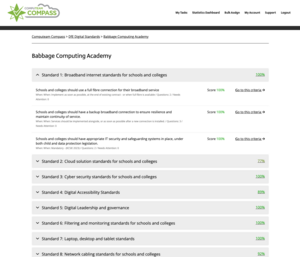
How Compass makes the broadband standard easy to track and evidence
Computeam Compass translates the DfE broadband internet standard into clear, trackable expectations. It gives schools and trusts a single place to see where they stand, what needs attention and who is responsible for next steps.
Make the expectations visible
Compass presents the broadband requirements as a structured set of criteria, aligned with the DfE guidance. Schools can record their current connection type, speeds, resilience arrangements and safeguarding controls against each point. Trust leaders gain a consistent view of how different sites compare, without needing to search through separate documents or emails.
Assign ownership and track actions
Where gaps are identified, Compass allows you to create actions with named owners and due dates. For example, you might assign tasks to investigate full fibre availability, review failover configuration, or confirm that firewall and filtering arrangements meet current safeguarding expectations. Progress is visible to SLT, IT managers and business staff, which supports timely follow-up and reduces the risk of tasks being forgotten.
Keep a secure, auditable record
Compass provides a secure space to store and reference key evidence, such as broadband contracts, supplier proposals, speed test logs and records of outages or safeguarding incidents linked to connectivity. Each update is time-stamped, so schools can demonstrate how decisions were reached and when reviews took place. This supports conversations with governors, trustees and external reviewers.
Give MAT leaders a trust-wide view
For multi-academy trusts, Compass brings information from multiple schools into one dashboard. Central teams can see which sites already meet the broadband standard, which are in progress and where there may be greater risk or urgency. This helps with planning collective procurements, prioritising upgrades and providing targeted support to individual schools.
Your next steps
If you are reviewing your broadband provision against the DfE standard, Computeam Compass can give structure and visibility to that work. It helps you record what is in place today, plan realistic improvements and maintain the evidence you need for internal assurance and external scrutiny.

See how Compass tracks the broadband standard and the wider DfE Digital and Technology Standards framework.

Explore Compass with your team and begin building a live picture of your school or trust’s digital standards.
Get in touch
See where you stand - and what to do next
Computeam Compass is now available for Computeam clients – and can be explored by any other MAT or School looking to adopt a clearer, more strategic approach to digital compliance.
Share a few details and we’ll send you a demo login and the quickest way to get started. You’ll get a clear view of where you stand, what to prioritise, and who needs to own each action.
 Updating page...