
The Department for Education’s (DfE) Digital and Technology Standards for Schools and Colleges have become a key reference point for education leaders seeking to improve resilience, security and long‑term sustainability.
Yet for many organisations, consistently interpreting these digital standards and ensuring that every school actually meets them remains a significant challenge.
Growth of a Multi-Academy Trust
As a trust grows, so does its digital complexity. Different sites inherit different systems, legacy infrastructure, varying levels of digital maturity and, in some cases, conflicting procurement decisions made years apart. So the question for high‑level leaders becomes:
How do you gain central visibility and control without undermining school autonomy? And how do you drive meaningful progress without overwhelming already stretched teams?
This is where Computeam’s Compass platform is making a meaningful difference for trusts looking to align fully with the DfE digital and technology standards.

The Challenge
Standards Without Structure
Most trust leaders agree with the intent behind the DfE digital and technology standards. The difficulty lies in making them operational.
Common challenges Education leaders highlight include:
Lack of consolidated data about the digital estate
Inconsistent adoption of cybersecurity policies
No single, trust‑wide view of network readiness, device age or cloud adoption
Local decision‑making that inadvertently increases long‑term costs
Difficulty evidencing compliance to auditors, boards and external partners
And perhaps the most recurring question:
How do we know what “good” looks like across all schools – today, not six months ago?
Without a unified digital strategy supported by live, accurate data, even the most well‑intentioned trust finds itself stuck reacting rather than planning.
A Different Approach
Introducing Compass
Computeam’s Compass has been designed specifically to address these trust‑wide challenges.
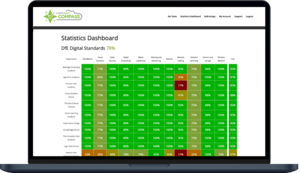
Compass gives MAT leaders a centralised, real‑time dashboard that maps each school’s position against the DfE’s digital and technology standards; covering networking, safeguarding, cyber security, cloud usage, devices, infrastructure and more.
Compass helps trust leaders to:
Understand digital risk at a glance
Standardise key systems and processes
Prioritise investments using evidence
Support a coherent, multi‑year digital strategy
Reduce costs by eliminating duplication and legacy technology
Ensure DfE digital and technology standards are met – and kept up to date
It puts you back in control of your digital estate, quietly reducing complexity while increasing impact.
What If You Could See Everything?
One of the most powerful aspects of Compass is the visibility it provides.
Imagine being able to answer, confidently:
-
Which of our schools are most at risk from outdated hardware or poor cyber practice?
-
Where will investment have the greatest impact on teaching and learning?
-
Which schools already align with the DfE digital and technology standards, and which are drifting?
-
How much money is tied up in underused or duplicated systems?
-
What will our estate look like in three years if we change nothing?
These are the questions leaders using Compass answer every day.

Thought‑Provoking Questions for Trust Leaders
As you evaluate your current position, it may be helpful to consider:
1. Do you have a single source of truth?
Or are you relying on spreadsheets, anecdotal reporting and out‑of‑date audits?
2. Are you confident your schools comply with DfE cyber security expectations?
Would you be able to evidence this tomorrow?
3. Is your digital spending aligned with your strategic plan?
Or is the strategy being shaped around existing procurement habits?
4. Can you track progress over time?
Not just a snapshot, but measurable movement across your trust.
5. Are you able to free up your leaders to focus on outcomes instead of infrastructure?
Digital leadership should never become an administrative burden.
If any of these questions cause hesitation, you’re in good company – and Compass was built to help.

Practical Actions You Can Take Now
Even before implementing a system like Compass, trust leaders can begin strengthening digital control and alignment:
1. Conduct a baseline maturity review
Assess where each school stands against DfE digital and technology standards.
2. Map your critical infrastructure
Identify what you must standardise (e.g., safeguarding platforms, Wi‑Fi consistency, backup solutions).
3. Prioritise cyber security
Ensure MFA, patching, filtering, and monitoring are consistent across all schools.
4. Define your 3‑year digital strategy
Set clear, trust‑wide expectations that support teaching, learning and sustainable growth.
5. Centralise procurement where sensible
Reduce duplication, negotiate better value and ensure quality control.
6. Establish regular reporting cycles
Data shouldn’t be collected once a year. It needs to be live, trusted and actionable.
Compass supports all of these actions; but the reflection process starts with leadership.

The Compass Advantage for MAT Leaders
MATs using Compass report three major benefits:
1. Confidence
Knowing where every school stands relative to national standards.
2. Control
Making informed decisions supported by clear, structured data.
3. Clarity
A shared trust‑wide roadmap that aligns digital operations with educational priorities.
It creates a common language between digital leaders, headteachers, finance teams and governors; reducing friction and increasing cohesion.
A Final Question for You
As a trust leader responsible for educational quality, safeguarding, digital resilience and financial stewardship, ask yourself:
Are you steering your digital strategy… or is your digital strategy steering you?
The right tools – and the right insights – make all the difference.


 Learning Locker
 Climate project
 Updating page...