
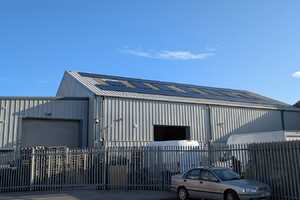
In September 2025, Computeam took another significant step on our journey towards Net Zero with the installation of a 33kW solar array on the roof of our Taunton office.
One year later, it's an ideal time to reflect on what we've learned, why we made the investment and what it might mean for schools and Trusts looking to reduce both costs and carbon emissions.
Turning an empty roof into an asset
Like many organisations, we had a resource hiding in plain sight: a large, uninterrupted roof space sitting above our Taunton office and warehouse facility.
Rather than allowing that space to go unused, we partnered with a local Somerset solar specialist to transform it into a source of renewable energy, helping to power both Computeam's operations and the two other tenants who occupy the building.
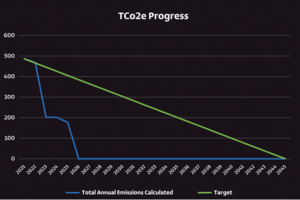
The installation forms part of the wider Computeam Climate Project, our long-term commitment to reducing emissions and achieving Net Zero ahead of the UK Government's 2050 target. In fact, our current Carbon Reduction Plan commits us to reaching Net Zero by 2045, five years earlier than the national objective.
As well as the environmental credentials, the project has also reinforced something we've long believed:
Sustainability projects deliver the greatest impact when environmental benefits and business benefits go hand in hand.
Why solar made sense for Computeam
Technology businesses consume electricity. Servers, networking equipment, charging devices, warehouse operations, lighting and day-to-day office activity all require energy.
Solar generation aligns particularly well with how most businesses operate because peak energy production occurs during daylight hours, when buildings are occupied and electricity demand is often at its highest, unlike the average home.
For us, investing in solar was an opportunity to:
Generate renewable electricity & reduce reliance on costly grid-supplied power
Improve the sustainability of our operations
Support our wider carbon reduction objectives
Make productive use of unused roof space
Contribute green energy to the wider building
The 33kW array has become one of several initiatives within our climate programme, alongside EV adoption, sustainable procurement, recycling initiatives, energy-efficient building upgrades and our ongoing partnership with Ecologi.
Since establishing our carbon reduction baseline in 2021, Computeam has reduced average emissions per employee by more than 80% through these and other initiatives, demonstrating how a combination of practical initiatives can produce substantial long-term change.
What does this mean for schools?
Schools are often uniquely well positioned to benefit from solar energy.
Consider the characteristics many education settings share:
-
Large roof areas
-
High daytime occupancy
-
Significant electricity consumption
-
Long-term ownership or occupation of buildings
-
Growing pressure to reduce operational costs
-
Sustainability objectives and climate commitments
The profile is remarkably well suited to solar generation.
Unlike many commercial buildings where energy demand may fluctuate significantly, schools consume electricity consistently throughout the day when solar panels are typically producing their highest output.
This raises an important question for school leaders:
If your roofs are already there and your energy demand already exists, could those buildings be generating more of their own power?
While every school's circumstances are different, energy generation and energy efficiency are likely to become increasingly important strategic considerations over the coming decade.
The educational opportunity
The benefits are not purely financial or environmental either.
Many schools are actively exploring ways to embed sustainability and climate awareness into everyday learning.
Renewable energy installations can become tangible examples of environmental responsibility in action.
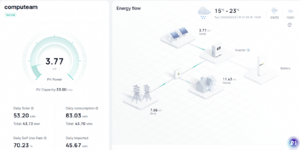
Rather than discussing sustainability only in theory, pupils can see how investments in renewable technology can help organisations reduce emissions and become more self-sufficient. We love looking at the solar data dashboard we got with our array, and we’re sure this could be a lead in to a myriad of lesson ideas!
For trusts seeking to demonstrate progress against sustainability objectives, solar projects can also provide visible evidence of their commitment to responsible operations.
A year later: a decision we're proud of
Looking back, installing the solar array was a straightforward decision that continues to support our wider environmental objectives. What began as an underutilised roof space is now actively contributing renewable energy to the building each day.
Combined with our broader carbon reduction initiatives, the project represents another practical step towards a more sustainable future.
Importantly, it demonstrates that carbon reduction doesn't always require revolutionary change. Sometimes it starts with identifying existing assets, asking a few different questions and finding better ways to use what you already have.
Could your school roof be working harder?
As organisations across the education sector explore ways to reduce costs, strengthen sustainability credentials and future-proof their estates, solar energy is increasingly part of the conversation, especially given the large, often flat roof spaces in most schools
If you're reviewing your sustainability strategy or considering how your estate could contribute to your wider environmental goals, we'd be delighted to share what we've learned from our own experience.
Because sometimes the most valuable sustainability asset is the one that's been above your head all along!
Find out more
To learn more about Computeam's Net Zero commitment and our wider sustainability initiatives, visit The Computeam Climate Project or explore our latest Carbon Reduction Plan.
And if you're a school or trust leader exploring renewable energy opportunities, we'd love to start the conversation about how technology, infrastructure and sustainability can work together to create lasting impact.


 Learning Locker
 Climate project
 Updating page...