
The Department for Education (DfE) has set out clear digital and technology standards to help schools and Multi-Academy Trusts (MATs) build secure, resilient, and future-ready digital environments. But here’s the truth: digital and technology standards are much more than an IT checklist – they’re a leadership responsibility.
Take a free 30 day trial of Compass: Our DfE Standards Tracker
Compass helps schools and MATs turn DfE guidance into clear actions, shared ownership and an audit-ready evidence trial.
Why Digital and Technology Standards Matter for Trust Leaders
The DfE’s guidance covers everything from broadband connectivity and wireless networks to cyber security, filtering and governance. Six of these standards become mandatory by 2030, and they underpin safeguarding, operational resilience and educational outcomes.
For trust leaders, forget simply ticking boxes. Digital and technology standards are about:
→ Protecting pupils and staff from online risks.
→ Ensuring compliance with statutory requirements.
→ Building confidence with boards, auditors, and Ofsted.
→ Driving strategic improvement, not just technical fixes.

The Risk of Leaving it to IT Alone
Too often, digital compliance is seen as “an IT job.” While IT teams play a critical role, the digital standards touch every part of your organisation, from governance and finance to teaching and learning. If leadership isn’t involved:
- Risks remain hidden until something goes wrong.
- Investment decisions lack strategic alignment.
- Boards operate on assumptions instead of evidence.
Digital readiness is a whole-trust responsibility, and accountability starts at the top.
What are the Core Digital & Technology Standards?
The Department for Education outlines 12 digital and technology standards, grouped into areas such as:

Connectivity
Broadband and wireless infrastructure

Security
Filtering, monitoring, and cyber resilience.

Leadership & Governance
Policies, planning, and oversight.

Cloud & Infrastructure
Servers, storage, and accessibility.
Six of these are considered critical for safeguarding and operational continuity, and they’re non-negotiable by 2030.
Where to Start
If you’re a trust leader asking, “Where do we stand?” You’re not alone. The first step is visibility:
→ Do you know which schools meet the digital and technology standards?
→ Can you evidence compliance for your board?
→ Are risks documented and prioritised?
Without a clear view, it’s impossible to plan effectively.

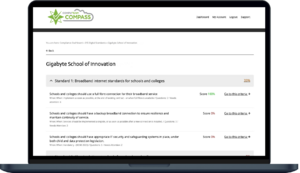
Introducing Computeam Compass
Computeam Compass is designed to make this process manageable. It transforms the Department for Education digital and technology standards into smart bit-sized practical questions, giving you:
→ Trust-wide dashboards for instant visibility.
→ Assign and track actions across schools.
→ Audit-ready reports for governance and funding bids.
Instead of spreadsheets and guesswork, Compass provides clarity and control – so leadership can lead.
Why This Matters Now
The clock is ticking toward 2030, and the sector is already seeing increased scrutiny around digital readiness. Trusts that act early will:
Reduce risk.
Build confidence with stakeholders.
Free IT teams to focus on innovation, not firefighting.
Next Steps
Start by reviewing the Department for Education digital and technology standards. Then, explore how Computeam Compass can help you turn those digital standards into a strategic advantage.
Get in touch
See where you stand - and what to do next
Computeam Compass is now available for Computeam clients – and can be explored by any other MAT or School looking to adopt a clearer, more strategic approach to digital compliance.
Share a few details and we’ll send you a demo login and the quickest way to get started. You’ll get a clear view of where you stand, what to prioritise, and who needs to own each action.


 Learning Locker
 Climate project
 Updating page...