
Across the school and trust landscape, conversations about digital strategy increasingly surface at board and executive level. Yet many of these discussions still hinge on assumptions rather than evidence.
Leaders may feel confident that staff seem digitally capable, that systems are probably being used well, or that the infrastructure is likely fit for purpose. But in an era where digital maturity directly influences organisational resilience, operational efficiency, and educational quality, “we think” is no longer sufficient.
Boards need clarity. Leaders need evidence. And schools need a shared digital language that supports informed decision‑making.
Why Assumptions Persist
Even the most experienced leadership teams can find digital evaluation challenging. Common issues include:
→ Digital competence is invisible until it is tested. Staff confidence can resemble capability – but isn’t always the same thing.
→ Legacy systems camouflage inefficiencies. Workflows may “function”, yet carry unseen workload and financial costs.
→ Boards receive narrative, not data. Leaders describe activity, but often lack the metrics to evidence impact.
And perhaps the most enduring assumption is this:
“Digital = IT’s Job”
Historically, digital operations sat firmly within the IT domain. But education has evolved. Our pupils now inhabit digital‑first futures; futures in which critical thinking, collaboration, content creation, information literacy and AI awareness are foundational skills.
If we are preparing young people for ambitious lives ahead, we must first embrace that digital world ourselves. That means digital can no longer be delegated to “the tech team”; it must be embedded in leadership culture, strategic priorities, curriculum design, operational planning and professional development.
Digital is not a technical function. Digital is a leadership function.
So here is a question for every board and executive team:
"If digital underpins teaching, learning, safeguarding, operations, and governance, why would digital leadership sit anywhere other than the heart of decision‑making?"

Reframing Digital Readiness as a Governance Priority
Digital maturity is now integral to how trusts operate and improve. It touches every strategic domain:
✓ Safeguarding and digital safety
✓ SEND and accessibility
✓ Curriculum ambition
✓ Workforce development
✓ Financial planning and procurement
✓ Operational efficiency
✓ AI readiness and governance
When boards lack visibility, risks stay hidden.
When boards gain clarity, strategic opportunity emerges.

From Guesswork to Metrics
Forward‑thinking trusts are shifting from anecdote to evidence through:
-
Staff digital competency baselines, aligned with recognised frameworks.
-
Usage analytics that reveal whether tools are being used effectively, or at all.
-
Digital accessibility reviews assessing provision for vulnerable and SEND learners.
-
Operational workflow audits highlighting gaps, duplication, and workload challenges.
Evidence replaces assumption. Insight replaces intuition.
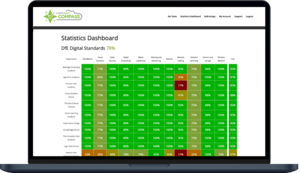
Where Computeam Compass Supports This Shift
This is precisely where Computeam Compass strengthens the leadership toolkit; as an intelligent framework that helps schools turn scattered digital realities into structured, actionable insight.
A single, coherent view of digital readiness
Instead of juggling spreadsheets, audits, staff surveys and anecdotal feedback, Compass consolidates the information that leaders need to make confident decisions.
A shared digital language for leaders, IT and educators
Compass reframes digital development as a whole‑organisation endeavour; ensuring that digital strategy is shaped by educational priorities, not just technical ones.
Data that speaks to board‑level governance
Rather than broad statements like “Staff are confident” or “Our systems work well”, Compass provides structured, repeatable evidence leaders can present to trustees with clarity.
A future‑focused model aligned to sector expectations
Compass aligns digital development to the skills, competencies and operational demands schools face today; and will face in the coming years, particularly around AI adoption and digital safety.
Questions for Trust and School Leaders to Consider
Do we truly know the digital strengths and needs of our workforce, or are we relying on intuition?
Can we demonstrate impact from our digital investments, or only activity?
Do our governors have the evidence needed to scrutinise digital risk and opportunity effectively?
Are we unintentionally delegating digital leadership to IT instead of embedding it across roles and responsibilities?
Do we have consistent digital standards across the trust, or isolated islands of excellence?
If any of these feel difficult to answer, Computeam are here to support, through Computeam Compass and our Digital Transformation Support Team.

Practical Takeaways: Three Steps You Can Take This Term
Embedding the Department for Education’s digital and technology standards into operational practice ensures that digital maturity is aligned to nationally recognised expectations. These three steps help leaders move from intention to implementation.
1. Establish a Digital Readiness Baseline
Use structured professional audits, staff voice tools and competency baselines to understand your current position. The DfE emphasises that schools should have a clear understanding of their capability and infrastructure, and Compass can support by providing a trust‑wide view that aligns directly with these digital and technology standards.
2. Map Digital Activity to Strategic Outcomes
Evaluate whether digital tools actively support curriculum ambition, inclusion and operational efficiency. The DfE expects schools to use technology purposefully and safely, ensuring that investment decisions are grounded in educational impact rather than assumption. Align each digital initiative with a defined digital and technology standard to strengthen strategic clarity.
3. Strengthen Board-Level Reporting
Boards should receive evidence‑based digital reporting: consistent metrics, one‑page dashboards and clear narratives linked to the DfE digital and technology standards. Compass supports leaders by consolidating data that aligns governance conversations with compliance expectations and sector best practice.
The Opportunity Ahead
Assumptions may get you started.
Evidence gets you further.
Start by reviewing the Department for Education digital and technology standards. Then, explore how Computeam Compass can help you give your board the evidence it needs.


 Learning Locker
 Climate project
 Updating page...